Is a Root Canal Worth It or Should You Extract the Tooth?
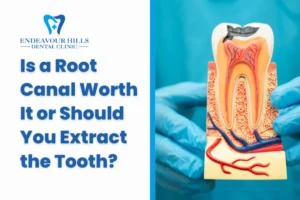
In most cases, a root canal is worth it if the tooth can be saved. Keeping your natural tooth is usually the better option for function, comfort, and long-term oral health.
That said, the decision is not always simple. It depends on how damaged the tooth is, how strong the surrounding bone and gums are, and what your long-term dental plan looks like. Some teeth can be predictably restored and last many years, while others may fail even after treatment. Understanding the difference is key to making the right choice.
What is a root canal and what does it do?
A root canal treats infection inside the tooth. The infected pulp is removed, the inside of the tooth is cleaned, and it is sealed to prevent bacteria from returning. This procedure is called Root Canal Treatment.
The goal is simple:
- Remove infection
- Stop pain
- Save the natural tooth
After the root canal, the tooth is usually restored with a crown. This is important because once the nerve is removed, the tooth becomes more brittle over time. A crown helps protect it from breaking under normal chewing pressure.
Saving the natural tooth has several advantages. It allows you to keep your original bite, maintain proper spacing between teeth, and avoid changes in how your jaw functions. Natural teeth also provide better feedback when chewing, which helps with comfort and control.
What happens if you extract the tooth?
Extraction removes the entire tooth from the mouth. While this may relieve pain quickly, it creates a gap that can lead to other problems if left untreated.
After extraction:
- Nearby teeth can shift into the space
- Your bite can change over time
- Bone in the area can shrink
Bone loss happens because the tooth root is no longer there to stimulate the jawbone. Over time, this can affect both function and appearance.
To replace the missing tooth, you may need:
- Dental Implant
- Bridge
- Denture
These options can restore function, but they involve additional cost, time, and procedures. In many cases, replacing a tooth ends up being more complex than saving it in the first place.
When is a root canal worth it?
A root canal is usually the best option when the tooth is still structurally sound and can be restored properly.
The tooth is restorable
- Enough healthy structure remains
If there is sufficient tooth left above the gum line, it can support a crown and function normally.
- No major cracks below the gum line
Cracks that extend deep into the root often reduce the success rate of treatment.
When the structure is strong enough, root canal treatment can provide long-term stability.
Infection is contained
- Infection has not destroyed surrounding bone
If the infection is localised, it can usually be cleaned effectively.
- Pain is coming from the nerve
This means the problem is inside the tooth, which is exactly what a root canal treats.
Treating infection early often leads to predictable and successful outcomes.
You want to keep your natural tooth
- Natural teeth function best
They provide better chewing ability and feel more natural compared to replacements.
- Avoids additional procedures
Keeping the tooth means avoiding surgery, implants, or bridges.
In most cases, preserving your own tooth is the simplest and most conservative approach.
When is extraction a better option?
There are situations where saving the tooth may not be realistic or predictable.
The tooth is severely damaged
- Large decay or fracture
If too much of the tooth is lost, there may not be enough structure to support a crown.
- Crack extends below the gum
These cracks often lead to ongoing problems even after treatment.
In these cases, extraction may prevent repeated issues and ongoing costs.
Advanced gum disease
- Bone support is already lost
If the tooth is loose due to bone loss, treating the nerve alone will not fix the problem.
- Poor long-term stability
The tooth may not remain stable even after a root canal.
Here, the issue is not just the tooth, but the surrounding support.
Cost and long-term planning
- Root canal + crown cost
This can seem higher upfront compared to extraction.
- Extraction alone may seem cheaper
However, once replacement is considered, the total cost often becomes higher.
Looking at the full treatment plan rather than just the first step helps make a better decision.
Which option lasts longer?
A properly treated root canal can last many years, and often decades, with good care. The success depends on how well the tooth is restored and maintained.
Extraction followed by an implant is also a long-term solution, but it involves surgery and healing time. Implants do not decay, but they still require healthy gums and bone to remain stable.
The key difference is that a root canal preserves your natural tooth, while extraction replaces it. Whenever possible, keeping natural structure is generally preferred because it maintains normal function with fewer interventions.
What should you consider before deciding?
Long-term outcome
Think about how long the solution will last. A root canal on a strong tooth can be very predictable, but a weak or heavily damaged tooth may not last even after treatment.
Cost over time
Compare the full cost, not just the initial procedure. A root canal with a crown may seem expensive, but replacing a missing tooth often involves multiple steps and higher total cost.
Comfort and recovery
A root canal is usually less invasive and has a quicker recovery. Extraction, especially when followed by an implant, may involve healing periods and multiple appointments.
Overall dental health
Your decision should also consider the health of your gums and surrounding teeth. A stable environment improves the success of any treatment.
When should you see a dentist?
If you are deciding between saving or removing a tooth, it is best to see a highly rated dentist near you for a proper assessment. A clinical exam and X-rays are needed to determine whether the tooth can be saved and how predictable the outcome will be.
You should seek advice if:
- You have ongoing tooth pain
- There is swelling or infection
- You were told you may need a root canal or extraction
- You are unsure which option is better
Getting a clear diagnosis early allows you to choose the most effective and cost-efficient option before the problem becomes more complex.
Quick summary
- A root canal is usually worth it if the tooth can be saved
- Keeping your natural tooth is often the best long-term option
- Extraction may be needed if the tooth is too damaged
- Replacing a tooth often adds cost and complexity
- A proper assessment is essential before deciding